Safety and risk analysis
STPA and CAST on one control structure
Agentic AI for System-Theoretic Process Analysis (STPA) and Causal Analysis based on STAMP (CAST). Generate a first study from one description, find unsafe control actions and loss scenarios, and learn from accidents on the same control structure, with results traced to requirements, fault trees and hazards.
Nancy G. Leveson and John P. Thomas, Massachusetts Institute of Technology (MIT). STPA Handbook (2018)Engineering a Safer World (MIT Press, 2011)
Overview
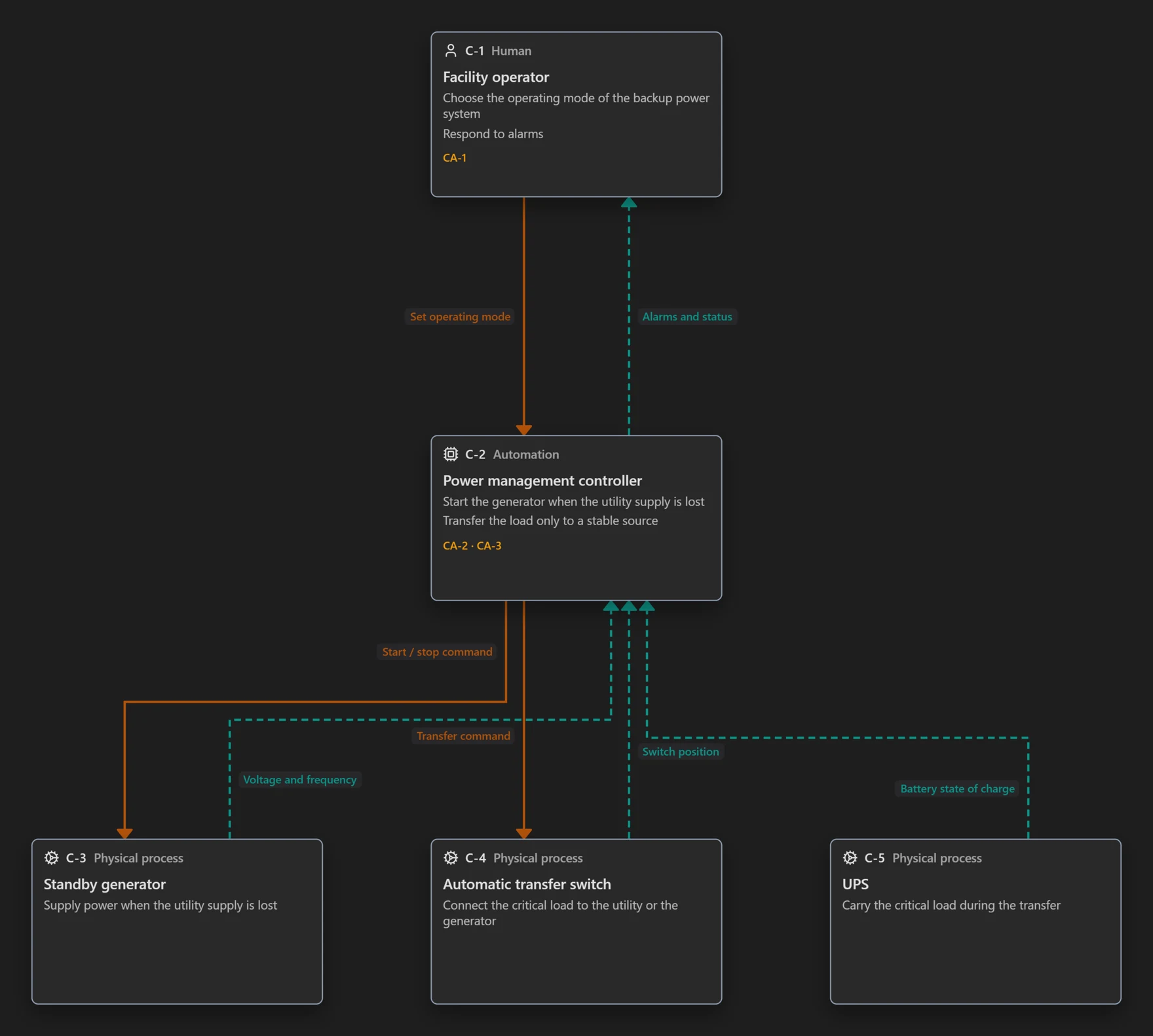
STPA treats safety as a control problem. Instead of starting from component failures, it asks how controllers, control actions and feedback in a socio-technical system can lead to hazards, including when every component works as designed. CAST applies the same model after an accident to find the inadequate control and the systemic factors that allowed it.
STAMP, STPA and CAST were created by Nancy G. Leveson at the Massachusetts Institute of Technology. John P. Thomas co-authored the STPA Handbook (2018), and CAST follows the CAST Handbook (2019). ModelGraphX is an independent implementation and is not endorsed by MIT.
In ModelGraphX you define losses, hazards and safety constraints, draw the control structure, identify unsafe control actions in the four handbook types, write loss scenarios and derive requirements. Readiness and completeness checks show what is still missing, and baselines need approval from someone other than the requester.
Capabilities
Losses, hazards and constraints
Define losses, hazards, sub-hazards and system-level safety constraints as the purpose of the analysis.
Control structure canvas
Draw controllers, control actions, feedback and controlled processes, with nested controllers you can open, linked to System Structure and real assets.
Unsafe control actions
Identify UCAs in the four handbook types in a matrix or list, with heat and gap overlays that show where analysis is thin.
Context tables
Build context tables from process-model variables and states, generate combinations and turn rows into UCAs.
Loss scenarios and requirements
Write loss scenarios for each UCA and derive requirements, with a readiness check that every UCA has a scenario and every scenario a requirement.
Coordination and completeness
Analyse controllers that share one process and check for missing losses, hazards, links, UCAs and scenarios.
CAST investigations
Record the loss event, controller analyses, belief gaps between design and what was observed, systemic factors and recommendations, starting from a copy of the design control structure.
Operations and change
Track assumptions with leading indicators and observations, and analyse changes against an approved baseline.
Review and baselines
Request baselines that someone else approves, compare them with the current study and discuss them in review comments.
Requirements sync and ReqIF
Push and pull requirements with the Requirements module, pull verification status back, and import or export ReqIF 1.2.
Fault trees and hazards
Create a fault tree from loss scenarios and CAST factors, and send hazards to Hazard Management.
Reports and templates
Export Word, PDF or PowerPoint reports with control-structure figures, and start from domain studies, a CAST teaching study or the CAST Handbook playbook.
AI assistance
- Generate a complete first STPA study from one description, or work step by step through thirteen agent modes.
- Propose unsafe control actions when you add a control action.
- Support CAST controller analysis and change analysis.
- Draft a report summary that you accept or edit. Nothing is written to the study until a person confirms it.
AI proposals are drafts: you review and accept them before they enter your model.
Standards and methods
- STPA Handbook (2018)
- STPA-Sec
- STAMP
- CAST Handbook (2019)
ModelGraphX supports work done under these standards and methods; it does not certify compliance.
Who uses it
- System safety engineers in aerospace, automotive, rail and defense
- Accident and incident investigators
- Security engineers applying STPA-Sec
- Universities teaching systems-theoretic safety
- Teams analysing software-intensive and autonomous systems
Works with
- Requirements
Safety constraints and requirements sync both ways, with verification status.
- Fault Tree Analysis
Loss scenarios and CAST factors can seed a fault tree.
- Hazard Management
Hazards found in STPA can be sent to the hazard register.
- System Structure
The control structure links to the system architecture it represents.
- Asset Management
Controllers and processes can link to real assets.
Frequently asked questions
- What is the difference between STPA and FMEA?
- FMEA starts from component failure modes and works up to their effects. STPA starts from losses and hazards and looks at how the control structure can behave unsafely, including when nothing has failed, such as wrong timing, missing feedback or flawed process models. Many teams use both; ModelGraphX supports both on the same project.
- Does ModelGraphX calculate probabilities in STPA?
- No. STPA is a qualitative method and the module has no probability fields by design. When you need quantification, loss scenarios can seed a fault tree in Fault Tree Analysis.
- Can I use STPA for security?
- Yes. A study can carry the STPA-Sec security lens, which applies the same control-structure analysis to security losses.
- Is ModelGraphX affiliated with MIT?
- No. ModelGraphX is an independent implementation of STPA and CAST. The methods were created by Nancy G. Leveson at MIT, and the product credits them and their handbooks.
- Can I exchange STPA requirements with other tools?
- Yes, through ReqIF 1.2 import and export. It is a file exchange, not a live connection to another requirements tool.
Try it on a real project
Explorer is free, and new accounts get a 30-day trial of the paid capabilities.