Skip to content
New: STPA and CAST

Know how your
system works. And how it can fail.

Requirements, architecture, behaviour, failure analyses and assets in one connected model. AI agents draft the work. Engineers make the calls.

Features

Free plan · No credit card

Fault tree for plant-level service loss: power and control subsystems, redundant channels behind AND gates, and shared earthquake and lightning hazards, evaluated to the top event probability.

Plant-level service loss (top event).

TOP-PLANTCCF/DEPP = 0.0000

Power subsystem fails to provide supply.

INT-POWER-LOSSSHAREDP = 0.0000

Control subsystem cannot maintain operation.

INT-CONTROL-LOSSSHARED+DEPP = 0.0000

Shared earthquake hazard used in both power and control branches.

Earthquake1P = 0.0150

Shared lightning hazard used in both power and control branches.

Lightning2P = 0.0300

Both redundant PSU channels fail.

INT-PSU-REDUNDANCYCCFP = 0.0000

Shared earthquake hazard used in both power and control branches.

Earthquake1P = 0.0150

Shared lightning hazard used in both power and control branches.

Lightning2P = 0.0300

Both controller channels fail.

INT-CONTROLLER-REDU…DEPP = 0.0000

Canonical UPS support loss event.

UPS Support FailureP = 0.0200

Canonical PSU channel A basic event.

PSU-A FailureP = 0.0400

Canonical PSU channel B basic event.

PSU-B FailureP = 0.0400

Canonical controller channel A event.

Controller-A FailureP = 0.0250

Canonical controller channel B event.

Controller-B FailureP = 0.0250

Every discipline. One platform.

Modules for systems engineering, safety, reliability, assets and knowledge, all working on the same model.
System structure
Requirements
System behaviour
Process management
FMEA
FTA
ETA
Bowtie
STPA / CAST
Hazard Management
Risk register
Dependability and reliability
Asset management
Map
Decision trees
Knowledge repository
Reference library
Case desk
OH&S management
Canvas
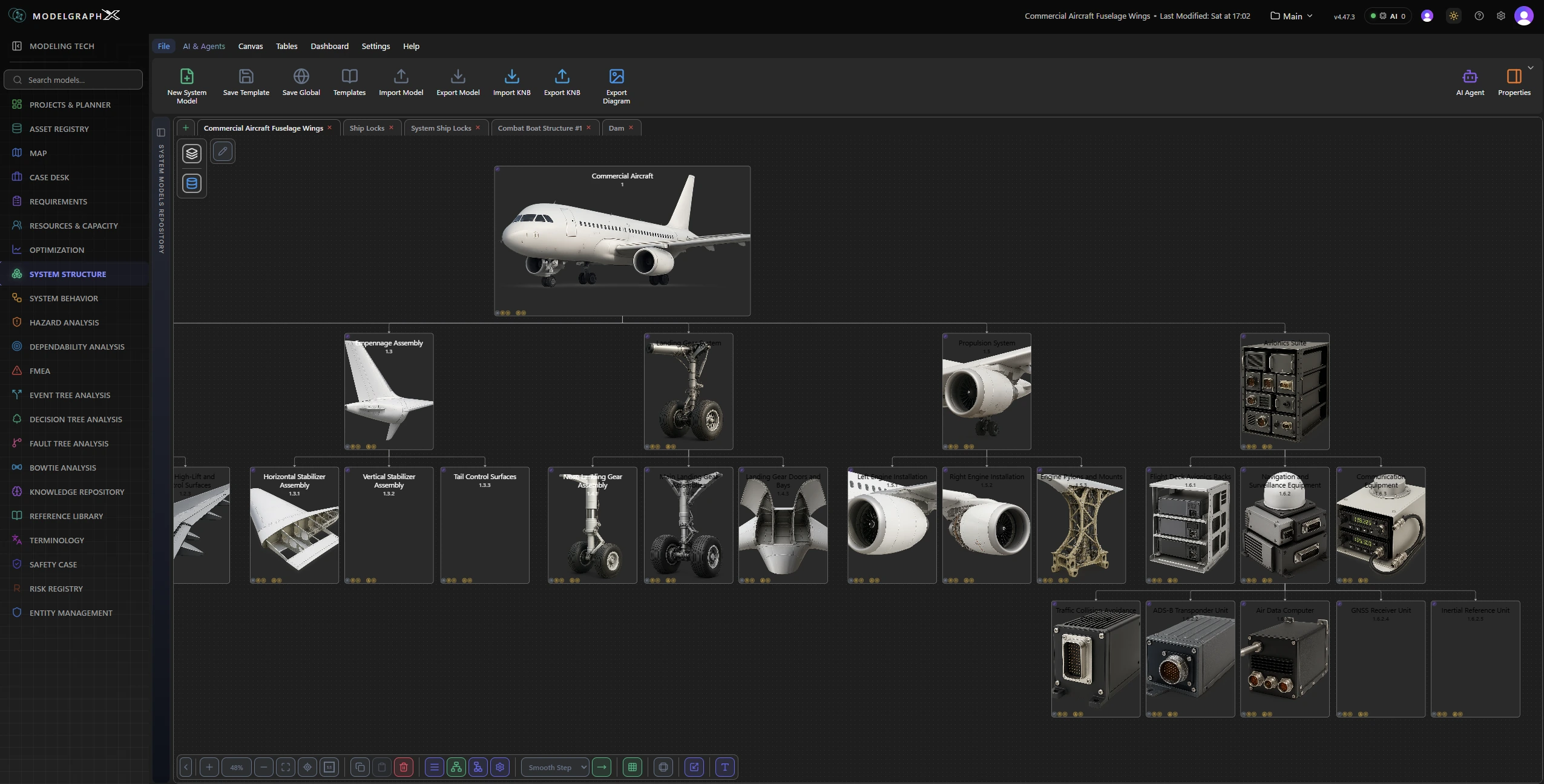
Aircraft system hierarchy with subsystems and components in ModelGraphX

Municipal pump station with two parallel pump trains, a shared suction header and remote control.

System model
Pump train APump train BSuction headerControl panel

Illustrative example. AI drafts are a starting point for your engineering review, not a finished analysis.

Presets and methods for the standards your reviewers expect

  • IEC 60812
  • AIAG-VDA
  • SAE J1739
  • MIL-STD-882E
  • MIL-STD-1629A
  • ISO 26262
  • IEC 61508
  • ISO 81346
  • STPA Handbook

One model of your system. Requirements, architecture, behaviour, failure analyses and assets stay connected, so every new analysis starts from what you already know.

Fig 0.1

Analyse failure

Find how components fail, how causes combine, and which safeguards change the outcome.

FMEA · FTA · ETA · Bowtie

Fig 0.2

Engineer safety

Identify hazards and unsafe control before operation, and investigate accidents without assigning blame.

STPA · CAST · Hazard analysis · Risk register

Nancy G. Leveson and John P. Thomas, Massachusetts Institute of Technology (MIT). STPA Handbook (2018)Engineering a Safer World (MIT Press, 2011)

Fig 0.3

Manage assets

Link each asset to its functions, condition and failure knowledge to plan maintenance and renewal.

Asset registry · Dependability · Map

Built for real systems and safety engineering work

Failure Mode and Effects Analysis (FMEA): find how each part can fail, what the failure causes and which controls reduce the risk. Score the risk and track actions through to residual risk.
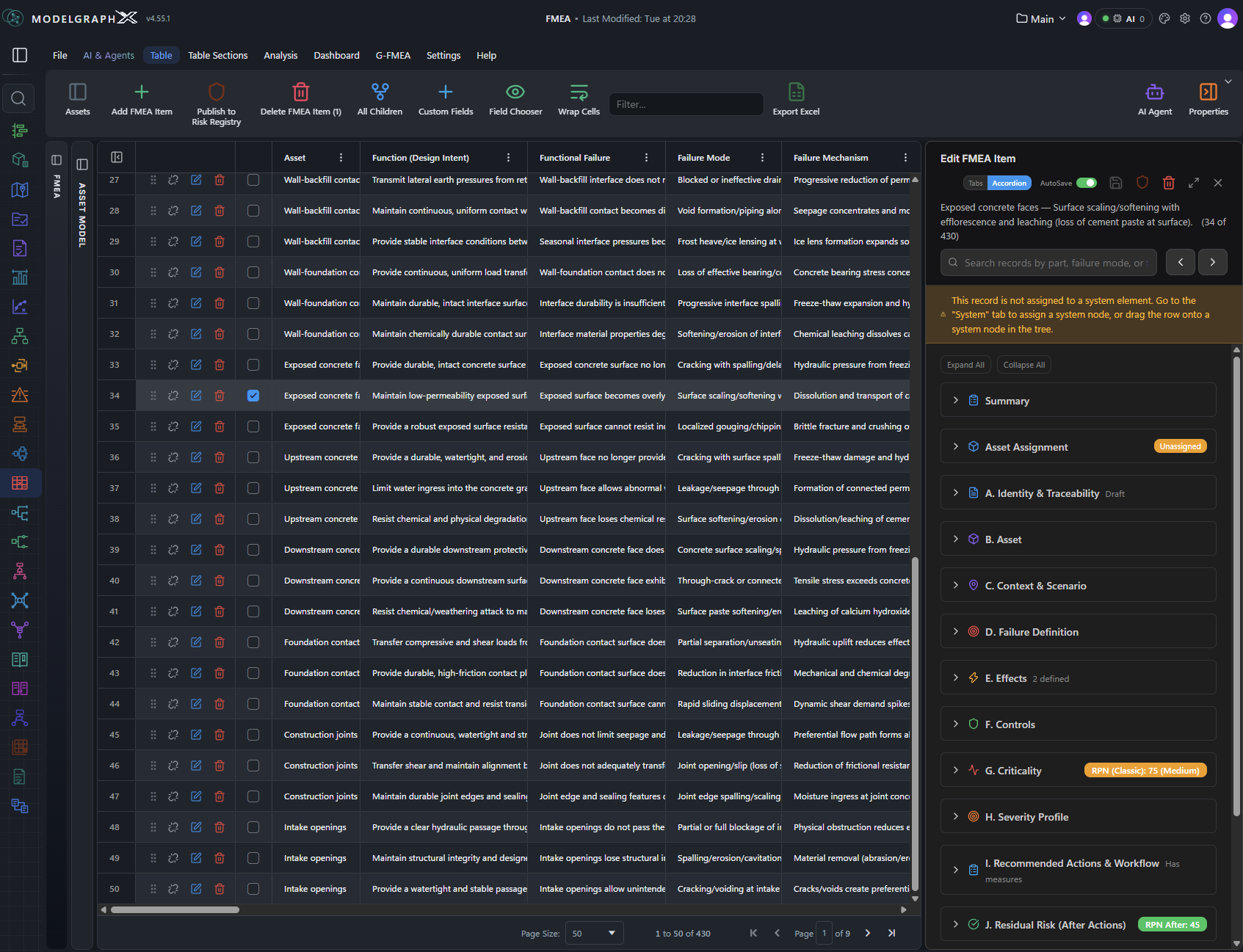
ModelGraphX FMEA worksheet with failure modes, effects and assessment columns.
See all modules

The future of systems and
safety engineering.
Available today.

Start free. Your first analysis costs nothing, and no credit card is needed.